I'd heard that having an input buffer op-amp as 'inverting' was a bad idea, because the gain was partly determined by the impedance of whatever guitar is plugged in... But if you used a non-inverting op-amp, the gain was set - regardless of what guitar you used.
Should I not be worried about this - and just go get a life or something?
Tedious technical question about input buffers
Moderator: Ghost Hip
Forum rules
The DIY forum is for personal projects (things that are not for sale, not in production), info sharing, peer to peer assistance. No backdoor spamming (DIY posts that are actually advertisements for your business). No clones of in-production pedals. If you have concerns or questions, feel free to PM admin. Thanks so much!
The DIY forum is for personal projects (things that are not for sale, not in production), info sharing, peer to peer assistance. No backdoor spamming (DIY posts that are actually advertisements for your business). No clones of in-production pedals. If you have concerns or questions, feel free to PM admin. Thanks so much!
-
D-Rainger

- experienced

- Posts: 510
- Joined: Fri Mar 25, 2011 8:15 am
- Location: London
- Contact:
-
Schlatte
- IAMILF

- Posts: 2667
- Joined: Mon Aug 08, 2011 3:27 pm
- Location: Austria
Re: Tedious technical question about input buffers
D-Rainger wrote:I'd heard that having an input buffer op-amp as 'inverting' was a bad idea, because the gain was partly determined by the impedance of whatever guitar is plugged in... But if you used a non-inverting op-amp, the gain was set - regardless of what guitar you used.
Should I not be worried about this - and just go get a life or something?
I will explain it to you as good as I can:
When you have a non-inverting OpAmp you have the guitar connected to the OpAmp itself... so there is no load that could draw current and "mess" with your impedance... if you have an inverting OpAmp you connect your guitar to the OpAmp via a resistor that determines the amplification (or boost) of the circuit.. so there is a load on the guitar that draws current..
I hope that helped...
Here the picture for explanation purposes:
- Attachments
-
Good Deals with: All these fine people!
MOM-D Shark Tank is back! Open Source Designs for musical pleasure! Back in the Tank! Go check it out!
MOM-D Shark Tank is back! Open Source Designs for musical pleasure! Back in the Tank! Go check it out!
-
D-Rainger
- experienced
- Posts: 510
- Joined: Fri Mar 25, 2011 8:15 am
- Location: London
- Contact:
Re: Tedious technical question about input buffers
Thanks! That does help.
So it is better to use non-inverting?
Also, aren't high-impedance guitars usually high output - negating any loss due to a load on the guitar?
So it is better to use non-inverting?
Also, aren't high-impedance guitars usually high output - negating any loss due to a load on the guitar?
-
Schlatte
- IAMILF
- Posts: 2667
- Joined: Mon Aug 08, 2011 3:27 pm
- Location: Austria
Re: Tedious technical question about input buffers
D-Rainger wrote:Thanks! That does help.
So it is better to use non-inverting?
Also, aren't high-impedance guitars usually high output - negating any loss due to a load on the guitar?
Usually, if you do it in a pedal.. you actually don't have a bipolar power supply (+/- 9V for example) for the OpAmp.. whats often done in pedals is that the positive input ("+") of the OpAmp just gets an offset (1/2 of the supply voltage- created via two resistors, see image 1 for explanation) and the signal is fed into the negative ("-") input... so it is actually getting inverted... also it works with a single supply.. but you have to pay attention to the amount of amplification when you use it as a buffer- remember using half the operating voltage is only 4,5 Volts in pedals that run off batteries... and unless you have a rail-to-rail OpAmp thats capable of supplying either it's full operating voltage or put it's output down to ground level you only have about +/- 3,5 Volts of headroom to spare, otherwise it distorts the signal...
Edit: As far as that:
D-Rainger wrote:Also, aren't high-impedance guitars usually high output - negating any loss due to a load on the guitar?
goes- I think with high output you mean higher voltage.. not like MOAR CURRENT! or something.. I mean a pickup is just a coil out of wire where current is produced via induction... you cant draw milliamps out of there... (I'm not quite sure if what I just wrote is true but I think so
 ... I guarantee for nothing
  )
)picture for explanation:
I took a big muff OpAmp version as a reference...
Here is the link to the Schem...
http://analogguru.an.ohost.de/193/schematics/EH_BigMuffPi_OP-77.gif

- Attachments
-
Good Deals with: All these fine people!
MOM-D Shark Tank is back! Open Source Designs for musical pleasure! Back in the Tank! Go check it out!
MOM-D Shark Tank is back! Open Source Designs for musical pleasure! Back in the Tank! Go check it out!
-
McSpunckle
- IAMILFFAMOUS

- Posts: 3848
- Joined: Mon Oct 06, 2008 10:20 am
- Location: Nashville, TN
Re: Tedious technical question about input buffers
If that's correct, then I've completely misunderstood inverting buffers.
I always thought with inverting buffers, you use equal resistor values for the feedback and input to get unity gain, and the input and output impedances are about the same as non-inverting (assuming you set them up for the same input impedance, that is).
One thing about inverting buffers, though, is that they -do- basically cut down your input signal, then boost it again. So noise could be an issue.
Too, if you wanted an inverting "buffer", and the output impedance wasn't a big issue, you could build an SHO and replace the 5K pot with a 5K6 resistor. You can do the same with an LPB. Just match the collector and emitter resistors. I do that from time to time and it works well.
As for pickups and such...
The loading that occurs on a guitar is a product of input impedance, and the guitar's inductance and output impedance. The output impedance of a guitar is pretty high, and the more turns you put on the pickup the more it goes up, along with the inductance of the coil. The inductance is what results in that loss of high end. High output pickups do tend to have higher output impedance, but it's the difference between 6K and 16K. You'd have to have a pretty low input impedance to really see a ton of gain reduction. It's the loss of high frequency loss that you really notice.
A good buffer will keep the input impedance high enough that the guitar will stay nice and bright, and drop the output impedance to something more like 100s of ohms of lower.
I always thought with inverting buffers, you use equal resistor values for the feedback and input to get unity gain, and the input and output impedances are about the same as non-inverting (assuming you set them up for the same input impedance, that is).
One thing about inverting buffers, though, is that they -do- basically cut down your input signal, then boost it again. So noise could be an issue.
Too, if you wanted an inverting "buffer", and the output impedance wasn't a big issue, you could build an SHO and replace the 5K pot with a 5K6 resistor. You can do the same with an LPB. Just match the collector and emitter resistors. I do that from time to time and it works well.
As for pickups and such...
The loading that occurs on a guitar is a product of input impedance, and the guitar's inductance and output impedance. The output impedance of a guitar is pretty high, and the more turns you put on the pickup the more it goes up, along with the inductance of the coil. The inductance is what results in that loss of high end. High output pickups do tend to have higher output impedance, but it's the difference between 6K and 16K. You'd have to have a pretty low input impedance to really see a ton of gain reduction. It's the loss of high frequency loss that you really notice.
A good buffer will keep the input impedance high enough that the guitar will stay nice and bright, and drop the output impedance to something more like 100s of ohms of lower.
-
mysteriousj
- committed

- Posts: 455
- Joined: Sun Mar 06, 2011 9:44 pm
- Location: NZ
Re: Tedious technical question about input buffers
Yip, so if you use high value resistors like 250K+ it won't be so much of a problem though right? I guess the difference between pickups etc would rarely be more than about 8k.Or the difference between humbuckers and single coils but i guess parallel and series wiring will make a bigger difference if you're into that....I can see how it could cause problems for some. Inverting op amps work out best for tremolo's though, cause you can just stick the LDR on the inverting input and it all works out nicely.
-
Narwhal-Industries

- committed
- Posts: 272
- Joined: Wed Jul 13, 2011 3:48 pm
- Location: Central Pennsylvania
- Contact:
Re: Tedious technical question about input buffers
Once you get above unity gain you don't really have a buffer anymore. Buffers are all about impedance correction. High input impedance, low output impedance. I like using a transistor as an emitter follower.

-
D-Rainger
- experienced
- Posts: 510
- Joined: Fri Mar 25, 2011 8:15 am
- Location: London
- Contact:
Re: Tedious technical question about input buffers
McSpunckle wrote:
Too, if you wanted an inverting "buffer", and the output impedance wasn't a big issue, you could build an SHO and replace the 5K pot with a 5K6 resistor. You can do the same with an LPB. Just match the collector and emitter resistors. I do that from time to time and it works well.
What's an 'SHO' and an 'LPB'?
-
Schlatte
- IAMILF
- Posts: 2667
- Joined: Mon Aug 08, 2011 3:27 pm
- Location: Austria
Re: Tedious technical question about input buffers
D-Rainger wrote:What's an 'SHO' and an 'LPB'?
EHX LPB-1, a Linear Power Booster...
Schem:
http://fuzzcentral.ssguitar.com/schematics/lpbschem.gif
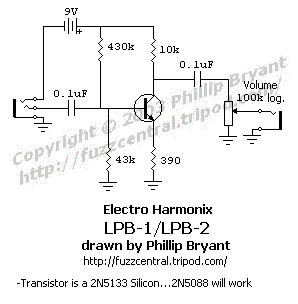
You could also use something like this:
http://www.muzique.com/tech/miniboo1.htm
looks pretty cool...

Good Deals with: All these fine people!
MOM-D Shark Tank is back! Open Source Designs for musical pleasure! Back in the Tank! Go check it out!
MOM-D Shark Tank is back! Open Source Designs for musical pleasure! Back in the Tank! Go check it out!
-
bubstance

- experienced

- Posts: 755
- Joined: Thu Jul 09, 2009 4:57 pm
- Location: uncanny valley
Re: Tedious technical question about input buffers
[quote="D-Rainger"What's an 'SHO' and an 'LPB'?[/quote]
Super Hard On and Linear Power Booster.
Super Hard On and Linear Power Booster.
powered by 9front
-
McSpunckle
- IAMILFFAMOUS
- Posts: 3848
- Joined: Mon Oct 06, 2008 10:20 am
- Location: Nashville, TN
Re: Tedious technical question about input buffers
D-Rainger wrote:McSpunckle wrote:
Too, if you wanted an inverting "buffer", and the output impedance wasn't a big issue, you could build an SHO and replace the 5K pot with a 5K6 resistor. You can do the same with an LPB. Just match the collector and emitter resistors. I do that from time to time and it works well.
What's an 'SHO' and an 'LPB'?
Sorry. Sometimes I'm a moron. People have answered what they stand for now. They're basically the same circuit, but the LPB is a bipolar transistor (the kind normally used in pedals), and the SHO is MOSFET. The SHO uses a different method for the gain control, but it's overall the same.
The names have basically become synonymous with the circuits, even though they're very basic circuits. Kinda like Kleenex and tissues.
The LPB schematic has been posted, so here's the SHO:
http://www.matsumin.net/diy/bunkai/Z_ve ... HO_sch.BMP
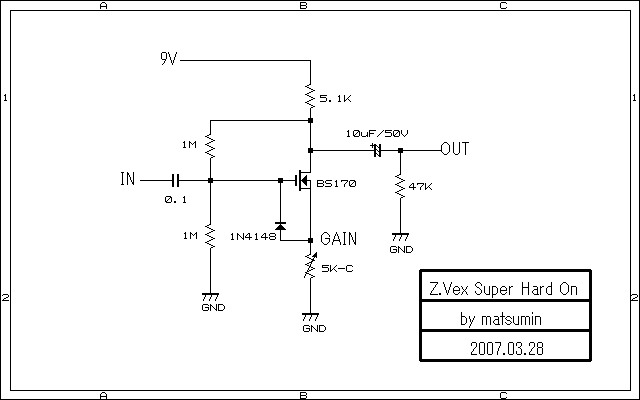
They'd work almost exactly the same, but the SHO has higher input impedance and lower output impedance, so it's closer to a real buffer.
-
Schlatte
- IAMILF
- Posts: 2667
- Joined: Mon Aug 08, 2011 3:27 pm
- Location: Austria
Re: Tedious technical question about input buffers
FullCustom wrote:Once you get above unity gain you don't really have a buffer anymore. Buffers are all about impedance correction. High input impedance, low output impedance. I like using a transistor as an emitter follower.
You get that by making R1 and R2 the same value. I also like to use a LPB-1-like transistor circuit as a buffer... but if I use an OpAmp like a LM306 or something in a pedal I might as well use one of the OpAmps in the IC as a buffer.... better than not using it and using a transistor instead...
Good Deals with: All these fine people!
MOM-D Shark Tank is back! Open Source Designs for musical pleasure! Back in the Tank! Go check it out!
MOM-D Shark Tank is back! Open Source Designs for musical pleasure! Back in the Tank! Go check it out!
-
eatyourguitar

- IAMILFFAMOUS
- Posts: 3127
- Joined: Sun Oct 03, 2010 12:37 pm
- Location: USA, RI
Re: Tedious technical question about input buffers
some of the LPB and rangemaster boosts I have tried on the breadboard to boost other fuzz circuits have been kinda funny with the mid boost or the treble boost. I'm starting to use shunts before the input cap as a simple filter but my understanding is limited and I do it all by ear. even though I have a RC filter calculator on my phone, it doesn't explain why everything I breadboard sucks. I'm just guessing that opamps should be easier to get a good flat buffer.
WWW.EATYOURGUITAR.COM <---- MY DIY STUFF