Forum rules
The DIY forum is for personal projects (things that are not for sale, not in production), info sharing, peer to peer assistance. No backdoor spamming (DIY posts that are actually advertisements for your business). No clones of in-production pedals. If you have concerns or questions, feel free to PM admin. Thanks so much!
You can have fuzz only, octave mayhem, or variations in between. For me, the fuzz is kinda so-so by itself, so I'll be tweaking mine so that there is always a fair bit of octave no matter where the Mix control is set. And in the future, I want to incorporate a different fuzz front-end. And maybe somehow combine it with my WTF?! octave up fuzz. That would rule.
There are some cool synthy, Atari-ish glitch things going on during note decay. Sounds pretty cool. In the second section of the demo below, I do simple single notes with the pedal set to do the funky Atari stuff. Changing pickups and adjusting guitar volume and tone controls make fairly noticeable changes in behavior. It's interactive, ya'll!!!
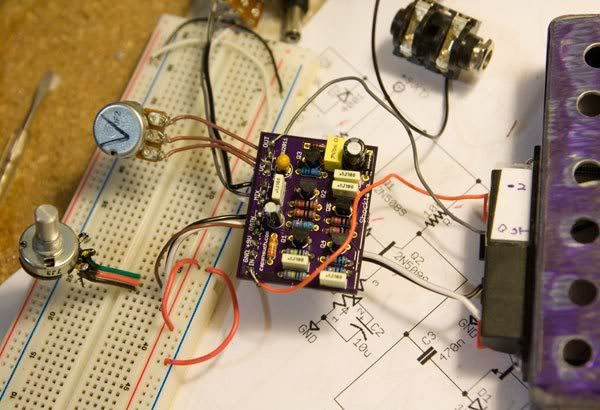
well it looks like the first stage is an emitter follower/think buffer. the next stage is common emitter more or less. Thats where your getting the gain. The criss crossed pair on the right is i think some sort of bistable latch configuraiton/flip flop. It will work as a frequency divider.
off the top of my head im not exactly sure what the middle transistor is doing. it will have somethign to do maybe with enabling/disabling the latch.
edit: actually the way the latch is set up i think it will just oscillate when its powered, which is effectively when the diode is forward biased. i will look at it again when its a bit earlier in the evening. (;
multi_s wrote:well it looks like the first stage is an emitter follower/think buffer. the next stage is common emitter more or less. Thats where your getting the gain.
*That* part I get.
But thanks for your insights.
Disclaimer #1: Co-Founder, Product Developer at Function f(x).
i would suggest looking at it on a scope but my guess is that on the base of the middle transistor you see a very pointy signal. IE very narrow pulse square wave. like
----|------|-----
only with the spikes alternating up and down.
A positive spike turns on the oscillator deal long enough for it to change states. A negative spike will do nothing i think. So the result is the oscillator changes state every high spike -> the frequency of the oscillators output is 1/2 the frequency of the input (in a perfect world). To me it seems though if the oscillator was on for too long you would get the same frequency out as the input. But maybe thats what gives it its character. THe blue box method is a bit more solid for getting octave downs i would say.
If you look at the astable multivibrator circuit here there is a description of how it works (see figure 1, look familiar? )
culturejam wrote:And maybe somehow combine it with my WTF?! octave up fuzz. That would rule.
O yes--FTW +1 googleplex give or take a few wins.
How would you do that--take the two roughly complete-ish circuits and smash them together in series? Take selected parts of each and combine them in a glitch-fizz souffle? Run them in parallel? All of the above?
Let'er rip, MR. Jam. I've got the Redenbackers.
"In a moment of unparalleled genius, Noel Parachute headed off this potential disaster by unplugging the microphone."






 )
)

 It sounds nice, though.