The4455 wrote:Phaser after distortion, especially fuzz. Intrestingly enough pedals go from right to left but effect eachother left to right. Time based effects such as phasers, flangers, and choruses have a blanketing effect on the rest of your pedals and should always go last in your chain; Unless your amp has a effects loop
example 2:
PumpkinPieces wrote:I put my phaser between two fuzz pedals... and turn both fuzzes on...
bnet: htsamurai#1534
instagram: lastoneawake
stanimal wrote:Ummm yeah, didn't realize we loved HT that much
The4455 wrote:Time based effects such as phasers, flangers, and choruses have a blanketing effect on the rest of your pedals and should always go last in your chain
htsamurai wrote:how to tell how long someone has been on ILF
example 1:
The4455 wrote:Phaser after distortion, especially fuzz. Intrestingly enough pedals go from right to left but effect eachother left to right. Time based effects such as phasers, flangers, and choruses have a blanketing effect on the rest of your pedals and should always go last in your chain; Unless your amp has a effects loop
example 2:
PumpkinPieces wrote:I put my phaser between two fuzz pedals... and turn both fuzzes on...
Fine whatever, I always put my time based effects last in my chain, you can put your pedals in whatever order you want, but that's just me
Also, I plead Noob where as Pumpkinpeices is expereinced, are you expereinced
It's interesting to see all the different takes. Also to see phaser called a time based effect, I've never thought of it like that -- it's a sweeping comb filter, not time-based modulation like chorus. I don't like the idea of putting a filter after a harmonically rich source like a fuzzed signal, but I also see a lot of guys putting wah after fuzz, so whatever works I suppose -- At one point engineers would tell you that distortion was wrong, so whatever sounds good to your ears is good by definition.
You'll get subtractive synthesis if you shove the phaser after the fuzz (the harmonic content is already produced by the dirt and the phaser will chop some of it out as the filter sweeps), additive if you stick it before (more emphasis on the fuzz at some frequencies than others, and it'll sweep).
The golden rule is always everything before everything else though.
But if you use amp distortion, you really don't have a choice (there's a dilemma, I like delay after distortion, but I also like my non-FX loop amp's natural drive, so how to get delay in there ? That's a PitA).
Good deals done with all these guys Canada, we put the "u" in satire
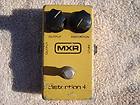
When i have the phaser after fuzz, i don't look for a standart fuzz sound when they're engaged so that's why i don't put the phaser before it
the coolest sound was when once i had the Ibanez FZ7 or whatever (the tonelock series), i plugged a Boss PH-2 (hands down, i still love the pedal) after it and turned on a Morley wah in front of it with the treddle all the way to the heel...
devnulljp wrote:It's interesting to see all the different takes. Also to see phaser called a time based effect, I've never thought of it like that -- it's a sweeping comb filter, not time-based modulation like chorus. I don't like the idea of putting a filter after a harmonically rich source like a fuzzed signal, but I also see a lot of guys putting wah after fuzz, so whatever works I suppose -- At one point engineers would tell you that distortion was wrong, so whatever sounds good to your ears is good by definition.
You'll get subtractive synthesis if you shove the phaser after the fuzz (the harmonic content is already produced by the dirt and the phaser will chop some of it out as the filter sweeps), additive if you stick it before (more emphasis on the fuzz at some frequencies than others, and it'll sweep).
I agree with you completely. While the concept of phase deals with time, I definitely see it more like a filter effect. My phaser is first in the change... well 2nd after the tuner.














 so that's why i don't put the phaser before it