Page 1 of 1
why is my vintage analog delay temperature sensitive?
Posted: Sat Feb 01, 2014 4:12 pm
by NDominy
So I've got a dod performer 585 and, with a soft touch switch and barrel style power jack installed, it's wonderful. Except... when it gets real cold, it stops working. Since my practice space isn't insulated, this is a problem. Any idea why this might be and if there's anything I can do to fix it? Or should I just sell it to someone in a warmer climate?
Re: why is my vintage analog delay temperature sensitive?
Posted: Sat Feb 01, 2014 4:32 pm
by rustywire
Most electronics have an operating range of min-max temperatures before failure or unintended/undesired behavior.
It likely has some critical component that is more susceptible to cold, or has a narrower operating range than the others.
Solution? How about a workaround? Take the pedal with you when you leave/arrive, so it's room temperature (or close to it) when ready for use.
Transport it in one of those hot-or-cold insulated bags and leave it somewhere you'll remember it, at home...by the door for example.
Reusable handwarmer (the kind you boil, then bend the metal disc); or warm it up inside your vehicle on the way to the space....etc.
Granted these are treating symptoms, not the cause...but I, too walk a balancing act...between a vintage DMM & germanium fuzzes.
The delay isn't a fan of the cold, the fuzz cant get enough of it. The things we do for the sound we want...
Re: why is my vintage analog delay temperature sensitive?
Posted: Sat Feb 01, 2014 5:51 pm
by NDominy
Hmm, I don't know if I'm attached enough to go through extensive workarounds, the thing isn't quite DMM level. I agree that its gotta be an overly sensitive critical component, do you think there's a way to pinpoint it and replace it? What types of components are typically the ones affected by temperature?
Re: why is my vintage analog delay temperature sensitive?
Posted: Sat Feb 01, 2014 6:37 pm
by Mike
What's it doing?
Is it not powering up at all, meaning no bypass signal? Is it powering up, but not switching out of bypass (no LED lighting up)? Is it powering up and switching out of bypass, but not putting out any sound... or just buffered sound with no delay?
Based on the information you provided, you already know the diagnosis: it doesn't work in the cold. With more details, someone might know why, or where to look.

Mike
Re: why is my vintage analog delay temperature sensitive?
Posted: Sat Feb 01, 2014 6:57 pm
by Scruffie
Nothing is particularly temperature sensitive in there (unless you're in minus 40 sort of temperatures) so i'd probably guess it's a bad cap, solder joint or the switching.
Possibly moisture from the cold causing issues.
How much do you want for it?
Re: why is my vintage analog delay temperature sensitive?
Posted: Sat Feb 01, 2014 7:02 pm
by NDominy
it'll pass signal, but won't switch on. at times, before it gets really cold, it'll switch on/off, but intermittently so. since it's an old DOD, it's not true bypass, but it does pass signal regardless... so could it be a component in the switching system?
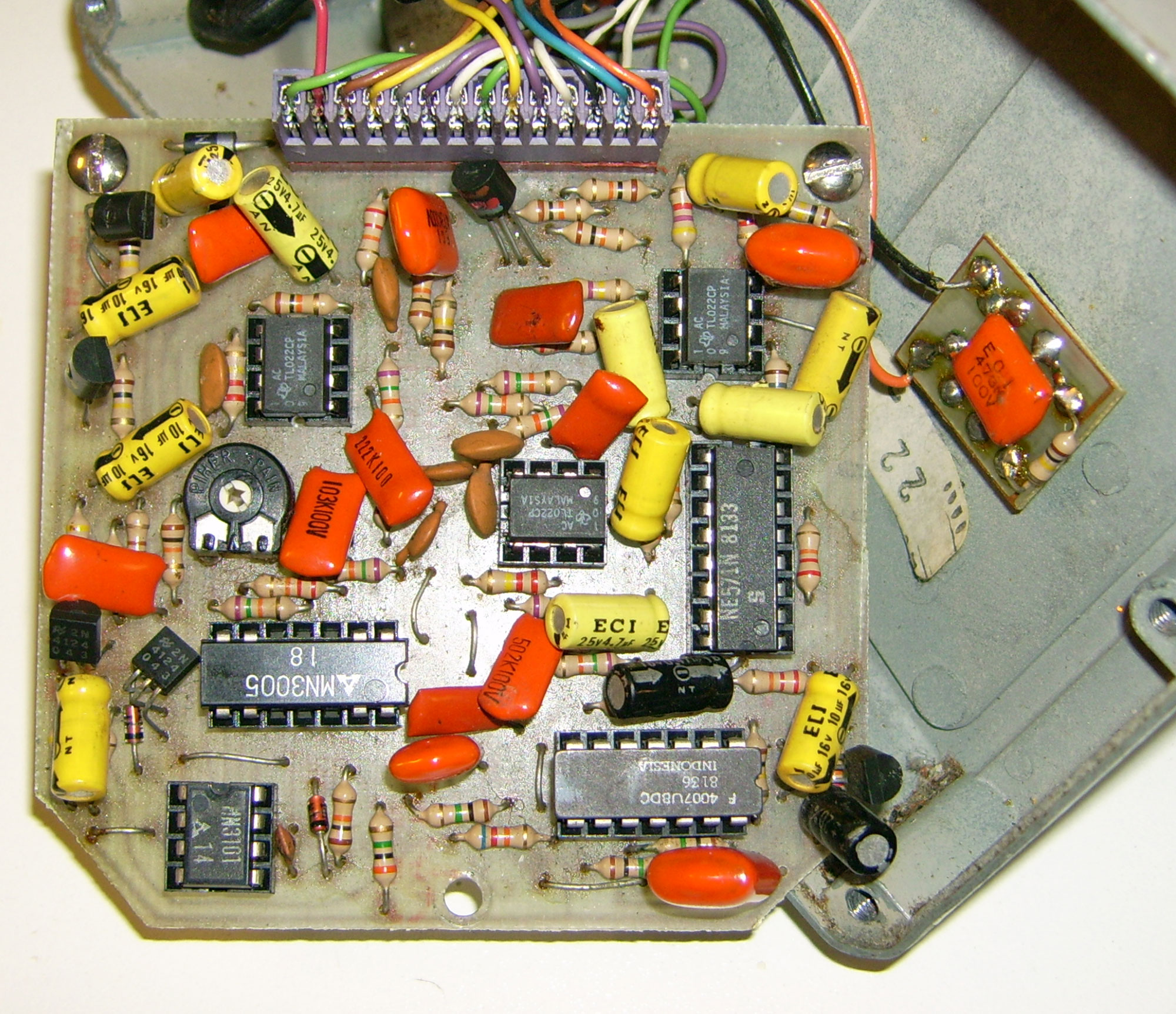
here's a pretty good picture of the board:
http://www.sonicurbs.com/dod585/board.jpg
and here's the schematic:
http://www.freeinfosociety.com/electron ... dod585.jpg
Re: why is my vintage analog delay temperature sensitive?
Posted: Sat Feb 01, 2014 7:04 pm
by NDominy
hm, bad cap is a very interesting idea... maybe I just need to start replacing possible culprits until the problem stops? and as for how much I want for it, I'll think about it

Re: why is my vintage analog delay temperature sensitive?
Posted: Sat Feb 01, 2014 7:27 pm
by Scruffie
Replacing parts randomly isn't a great way to debug...
So it sounds like it's just the switching, it may well be the switch itself. As with most DOD pedals the switching is done by the 4007 and associated components so that'd be where i'd start digging.
Re: why is my vintage analog delay temperature sensitive?
Posted: Mon Feb 03, 2014 5:43 am
by McSpunckle
Maybe clean the contacts in the sockets, too. Some rubbing alcohol would do the trick (pure isopropyl is better, but hey!). Maybe they've gotten grimy over the years and the cold is causing what ever's in there to... change.
But, yeah, I agree with Scruffs. Changing stuff out "just to see" isn't a great way to debug if you can help it. The best way is to figure out how the parts work and take measurements until you find the problem. It's obviously in the switching mechanism, but that leaves quite a lot of options left.
Re: why is my vintage analog delay temperature sensitive?
Posted: Mon Feb 03, 2014 11:19 am
by Dr. Sherman Sticks M.D.
i always thought it was because it was too cold for the little tone elves inside the pedal to go to work that day. SNOOOW DAY
Re: why is my vintage analog delay temperature sensitive?
Posted: Thu Feb 06, 2014 6:55 pm
by NDominy
I think I phrased myself carelessly- I wouldn't just go replacing parts at random. I'm actually warming (LOL) up to the idea of selling this guy if anyone's interested, I've gotten pretty comfy with my backup since this one's been giving me trouble and could use the money for a verb of some sort. I'm also student teaching, so time to fix it properly does not exist

Re: why is my vintage analog delay temperature sensitive?
Posted: Sat Feb 22, 2014 8:38 pm
by NDominy
Maybe clean the contacts in the sockets, too. Some rubbing alcohol would do the trick (pure isopropyl is better, but hey!). Maybe they've gotten grimy over the years and the cold is causing what ever's in there to... change.
Quick update, just in case anyone else winds up here with a similar DOD problem: cleaning the contacts for the 4007 chip did the trick! It works in the cold again!

It seems like it might be slightly noisier now, but not enough to notice while actually playing with a band. McSpunckle, I owe you a beer.
Re: why is my vintage analog delay temperature sensitive?
Posted: Fri Feb 28, 2014 1:11 pm
by Scruffie
Awesome
glad you got it sorted, something that wouldn't have crossed my mind unless it was clearly dirty.