Page 1 of 1
Do I need a buffer?
Posted: Sat Apr 09, 2011 9:50 am
by bpamier
hey - i have a lot of gear:
zvex fuzz factory
blackcat od/fuzz
ehx pog2
eventide pitchfactor
pigtronix philosopher king
ehx #1 echo
mojohand 770 flanger
malekko analog chorus
malekko analog vibrato
mxr six band eq
ehx holy stain
ehx cathedral
ehx pulsar
ehx stereo memory man
and i play a Jazzmaster, so I like a chime-like tone to my guitar. At around 7-8 pedals, I was experiencing a lot of tone loss, which cleared up nicely when I put the POG2 toward the start of the chain. Now, several pedals later, the POG2 doesn't help as much as it used to.
Do I need a buffer? If so, where do I put it? Can you recommend one? Is the MXR Micro Amp pretty cool?
Re: Do I need a buffer?
Posted: Sat Apr 09, 2011 10:02 am
by sylnau
Try this...
1-Plug your guitar directly in your amp (no pedals)... listen to your tone.
2-Plug your guitar through all your pedals going to the amp... listen to your tone.
If there's a big difference, a buffer can help you.
Montreux "Little Buffer" is a good one.
http://www.axeandyoushallreceive.com/im ... ffer01.jpgFrom Montreux:
The "Little Buffer" is the third original Montreux pedal, following the Knebworth and CODA. With the addition of effects there is the addition of wiring, with the wiring in effect pedals and the long cables it start's adding resistance which robs your highs and the low end punch of the guitar/bass. Even a short instrument cable will start robbing you of your tone, it doesn't matter how expensive your cables are. The "Little Buffer" brings your tone back to where it should be.
One of the main priority's in designing the "Little Buffer" was size, so you can add it to your pedal board with out taking up precious space. Because of the small size of this pedal, a 9v battery can not be used with it, only a 9v (center pin negative) adapter can be used. It works best directly after the guitar/bass, with larger effect chains, a second will also work best at the end of the board. The "Little Buffer" is not an effect, it is a pedal that brings your instruments tone back to it's natural state.
SPECIFICATIONS:
Size : 52mm x 63mm x 32mm
Weight : 85g
Handbuilt in U.S.APersonallyI don't use one so I cannot help more than that.
Re: Do I need a buffer?
Posted: Sat Apr 09, 2011 10:19 am
by bpamier
Thanks for the recommendation on the buffer. I've tried the tests you mention above and yes, there is a serious amount of tone loss. The only thing that helps is turning the POG2 on at the front of the chain (after the fuzzes).
Anybody else out there with a similar experience? Did a buffer help? Would you place it at the end of the chain, around the SMMH?
Re: Do I need a buffer?
Posted: Sat Apr 09, 2011 11:14 am
by sylnau
bpamier wrote:Thanks for the recommendation on the buffer. I've tried the tests you mention above and yes, there is a serious amount of tone loss. The only thing that helps is turning the POG2 on at the front of the chain (after the fuzzes).
Anybody else out there with a similar experience? Did a buffer help? Would you place it at the end of the chain, around the SMMH?
I don't know for the POG2... but I had a MicroPOG. It was sucking my tone.
In front of fuzz pedals, it kill them.
I replace the MicroPOG with the FoxRox Octron.
Try same thing without the POG2 in your chain to see if it is responsable for your tone lost.
Re: Do I need a buffer?
Posted: Sat Apr 09, 2011 11:17 am
by bpamier
Yeah, checked that one too. Turning the POG2 on and using it as a clean boost actually improves things about 80%. What I'm looking for here is how to get that other 20% back.
Re: Do I need a buffer?
Posted: Sat Apr 09, 2011 1:51 pm
by ural
Re: Do I need a buffer?
Posted: Sat Apr 09, 2011 11:50 pm
by Green Jacket
sylnau wrote:In front of fuzz pedals, it kill them.
Especially something like the fuzz factory
Re: Do I need a buffer?
Posted: Sat Apr 09, 2011 11:54 pm
by rbtr
bpamier wrote:Thanks for the recommendation on the buffer. I've tried the tests you mention above and yes, there is a serious amount of tone loss. The only thing that helps is turning the POG2 on at the front of the chain (after the fuzzes).
Anybody else out there with a similar experience? Did a buffer help? Would you place it at the end of the chain, around the SMMH?
I'm pretty sure that the SMMH uses a buffer and is not true bypass. So putting a buffer beside ot would do rather little
I could be very wrong though

Re: Do I need a buffer?
Posted: Sun Apr 10, 2011 10:06 pm
by Toonster
I play more Boss-pedals than I originally thought I would (OC-2, PS-2, RV-3) So personally I have enough buffers.
I don't know what a dedicated buffer costs but isn't a buffered pedal you like a better option?
Or if the tone loss still is occurring with the buffers in the signal chain, maybe it is time to use some true-bypass loopers..
Re: Do I need a buffer?
Posted: Mon Apr 11, 2011 11:03 am
by mauerkraut
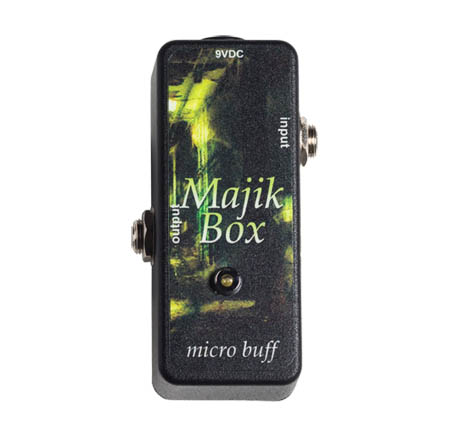
Look into Majik Box MB1 Micro Buff. I've heard great reviews. What I do is turn the volume all the way on my compressor to keep my signal alive throughout the chain.
Re: Do I need a buffer?
Posted: Mon Apr 11, 2011 3:05 pm
by dubkitty
i'm afraid that what you really need is fewer and higher-quality delays and modulation units. you've got a whole gaggle of stuff in series that's not exactly tone-friendly:
ehx #1 echo
mojohand 770 flanger
malekko analog chorus
malekko analog vibrato
mxr six band eq
ehx holy stain
ehx cathedral
ehx pulsar
ehx stereo memory man
any one of those is going to degrade tone with the possible exception of the MojoHand flanger; putting nine of them in a row is like covering a lawn with six inches of topsoil. you could get the equivalent amount of processing from maybe four higher-quality units.
alternately, you might consider a true-bypass loop box to split the effects chain so boxes you don't use frequently are cut out of the circuit. i have an A/B looper which i use to switch the rack gear in/out, and have also used it to split the pedalboard into two chains in order to cut out the big array of fuzz when it's not in use.
