Page 371 of 1757
Re: The spite, hate, rage, apathy and mild irritation thread
Posted: Wed Dec 07, 2011 1:37 am
by Grrface
I, too, need to quit procrastinating on this paper. I've only got about a page left, but I've run out of stuff to say about this stupid book.
Re: The spite, hate, rage, apathy and mild irritation thread
Posted: Wed Dec 07, 2011 1:40 am
by the_carl
jfrey wrote:Caesar wrote:Pssst. Yer friend is correct as it pertains to language. Language, pronunciation, grammar, and even meanings are based on popular convention.
No he isn't. If I got a million people saying that "tetrahedral" was pronounced "ajax" it still wouldn't be correct. The fact that it's popular doesn't make it right. Not at all. And, before you say that it isn't the same thing, it is. Just on a different scale. Letters are just "accepted" symbols that represent sounds.
Well, languages have to evolve somehow, don't they? Changes in pronunciation, spelling, usage, etc. are going to happen over time because languages aren't static. Take American vs. British English, for example. Are all the differences that have made their way into American English "wrong"? And if you're claiming that letters have to represent certain sounds always, what about sequences like "ough" that can take on different pronunciations arbitrarily depending on the word?
Re: The spite, hate, rage, apathy and mild irritation thread
Posted: Wed Dec 07, 2011 2:02 am
by snipelfritz
the_carl wrote:jfrey wrote:Caesar wrote:Pssst. Yer friend is correct as it pertains to language. Language, pronunciation, grammar, and even meanings are based on popular convention.
No he isn't. If I got a million people saying that "tetrahedral" was pronounced "ajax" it still wouldn't be correct. The fact that it's popular doesn't make it right. Not at all. And, before you say that it isn't the same thing, it is. Just on a different scale. Letters are just "accepted" symbols that represent sounds.
Well, languages have to evolve somehow, don't they? Changes in pronunciation, spelling, usage, etc. are going to happen over time because languages aren't static. Take American vs. British English, for example. Are all the differences that have made their way into American English "wrong"? And if you're claiming that letters have to represent certain sounds always, what about sequences like "ough" that can take on different pronunciations arbitrarily depending on the word?
Linguists have determined that American English is actually closer to the "King's English" when the split in the two languages occurred. Languages changing is a lot like evolution: It starts at one point and goes in two different directions.
The only "correct" way to speak is the way that makes you sound less like an idiot.
Re: The spite, hate, rage, apathy and mild irritation thread
Posted: Wed Dec 07, 2011 2:14 am
by jfrey
the_carl wrote:jfrey wrote:Caesar wrote:Pssst. Yer friend is correct as it pertains to language. Language, pronunciation, grammar, and even meanings are based on popular convention.
No he isn't. If I got a million people saying that "tetrahedral" was pronounced "ajax" it still wouldn't be correct. The fact that it's popular doesn't make it right. Not at all. And, before you say that it isn't the same thing, it is. Just on a different scale. Letters are just "accepted" symbols that represent sounds.
Well, languages have to evolve somehow, don't they? Changes in pronunciation, spelling, usage, etc. are going to happen over time because languages aren't static. Take American vs. British English, for example. Are all the differences that have made their way into American English "wrong"? And if you're claiming that letters have to represent certain sounds always, what about sequences like "ough" that can take on different pronunciations arbitrarily depending on the word?
If a change is based on a mistake then it is incorrect no matter how many people pick it up. A divergence in language doesn't have to be based on a mispronunciation or mistake. As technology, culture, environment, etc. change it creates new meanings that need words, which in turn affect our speech, or subtly alters the meanings of current words, by which it is natural and may be considered correct if our modes of speech change.
So is much of current English - of any nation, or accent, or whatever - incorrect? Most definitely, although not
necessarily.
Re: The spite, hate, rage, apathy and mild irritation thread
Posted: Wed Dec 07, 2011 2:34 am
by snipelfritz
Incorrect implies a finite "correct" form. There really isn't a big book or correct English. Dictionaries are still written by people at a certain point in time.
Re: The spite, hate, rage, apathy and mild irritation thread
Posted: Wed Dec 07, 2011 2:41 am
by the Life Aquatic
sooooooooooo stressed. next week or so will decide if im off academic probation, can keep my scholarship, not get disowned by my parents, and stay in school. ive worked my ass off this semester and it might not have paid off, fuck. top of my class for both accounting class, Bs in 2 others. but fucked up the midterm for the 1 class and am risking getting a D. i need to ace 4 of my finals ths week. hopefully pull those two Bs to B+s fuck.
Re: The spite, hate, rage, apathy and mild irritation thread
Posted: Wed Dec 07, 2011 2:55 am
by phantasmagorovich
jfrey wrote:the_carl wrote:jfrey wrote:Caesar wrote:Pssst. Yer friend is correct as it pertains to language. Language, pronunciation, grammar, and even meanings are based on popular convention.
No he isn't. If I got a million people saying that "tetrahedral" was pronounced "ajax" it still wouldn't be correct. The fact that it's popular doesn't make it right. Not at all. And, before you say that it isn't the same thing, it is. Just on a different scale. Letters are just "accepted" symbols that represent sounds.
Well, languages have to evolve somehow, don't they? Changes in pronunciation, spelling, usage, etc. are going to happen over time because languages aren't static. Take American vs. British English, for example. Are all the differences that have made their way into American English "wrong"? And if you're claiming that letters have to represent certain sounds always, what about sequences like "ough" that can take on different pronunciations arbitrarily depending on the word?
If a change is based on a mistake then it is incorrect no matter how many people pick it up. A divergence in language doesn't have to be based on a mispronunciation or mistake. As technology, culture, environment, etc. change it creates new meanings that need words, which in turn affect our speech, or subtly alters the meanings of current words, by which it is natural and may be considered correct if our modes of speech change.
So is much of current English - of any nation, or accent, or whatever - incorrect? Most definitely, although not
necessarily.
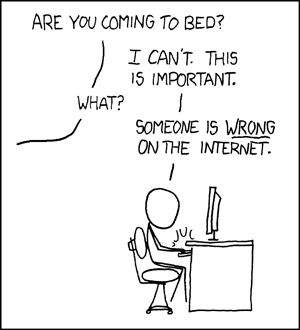
You are wrong.
Re: The spite, hate, rage, apathy and mild irritation thread
Posted: Wed Dec 07, 2011 3:42 am
by alexa.
He is not wrong. If you say "a porcupine is a yellow tree", either your language has entirely different meaning and you can't understand what I'm saying now (and I can't understand what you wanted to say either), you're trippin' balls, or you're wrong cuz that sentence does not describe facts based in reality.
Also, snipelfritzs quote below.
Re: The spite, hate, rage, apathy and mild irritation thread
Posted: Wed Dec 07, 2011 4:22 am
by 01010111
Anyone else got a case of the mean reds?
Re: The spite, hate, rage, apathy and mild irritation thread
Posted: Wed Dec 07, 2011 4:33 am
by colin
I'd say that both jfrey and his friend are correct in certain ways, there is validity to both sides of the argument. Just because lots of people pronounce a word wrong doesn't mean that that pronunciation is suddenly correct. But language is constantly evolving, incorrect pronunciations that become sufficiently prevalent over time eventually become the accepted form.
Re: The spite, hate, rage, apathy and mild irritation thread
Posted: Wed Dec 07, 2011 5:07 am
by phantasmagorovich
alexa. wrote:He is not wrong. If you say "a porcupine is a yellow tree", either your language has entirely different meaning and you can't understand what I'm saying now (and I can't understand what you wanted to say either), you're trippin' balls, or you're wrong cuz that sentence does not describe facts based in reality.
Also, snipelfritzs quote below.
You are arguing semantics, which is completely different from pronounciation.
But even so, if a sufficient number of people agree that eg the verb fail is used in place of the noun failure it assumes that role. Because people use it that way. Language and communication is just a set of conventions between humans. Nothing is wrong or right, it can be agreed upon or not. The basic rule is that you try to be understood. Which is why you try to understand sets of agreements that are used by people (and I use a common language in between us here on ilf, because there is the agreement that we call this:

tree and not árvore or Baum, which might be the case if you look elsewhere.
And the other rule is that you try to keep it as simple as possible, which is the reason for some verb forms disappearing for example. (Is there a future tense in english?)
Re: The spite, hate, rage, apathy and mild irritation thread
Posted: Wed Dec 07, 2011 5:15 am
by Bassus Sanguinis
lol @ people splitting hairs about the worlds most spoken language, Broken English. In the
internet? Oh boy.


I've been corrected over the use of Your /You're in school far too often for me to give a shit anymore, BUT I DO understand the approach of jfrey here, leaning to absolute logic and linguistics rigor. I couldn't do without the same approach to things in my work at the university. Also, I've been called a grammar police.
There IS grammatical correctness. It can be overlooked but that doesn't make it disappear. Try the same with speed limits and try telling the officer
everybody's speeding after that crossing, c'mon, don't be so stiff,man, please don't give me a ticket. The grammar is printed and spoken and the proper language is taught in schools. And - yes- it is, like any languages, in ever-evolving process, and thus always following the spoken version in use. So the incorrect spoken language is, in a sense, the pioneer work of the correct grammar, right? People can mutilate even the most beautiful languages and they can't be taken to the court of justice for their crimes against their native language AND instead their negligence might be approved afterwards.
But especially in the internetz, it's not just apples and oranges. Being right about grammar - anything really - has become a major resource of seemingly endless lulz.
I should, of course, as a non native speaker keep a distance to the argument

BUT since I sensed the time for 2011 nominations were here, I decided to jump in

Re: The spite, hate, rage, apathy and mild irritation thread
Posted: Wed Dec 07, 2011 5:32 am
by the_carl
Re: The spite, hate, rage, apathy and mild irritation thread
Posted: Wed Dec 07, 2011 5:33 am
by Haki
Bassus Sanguinis wrote:People can mutilate even the most beautiful languages and they can't be taken to the court of justice for their crimes against their native language AND instead their negligence might be approved afterwards.
Worst thing about the legal system.
Re: The spite, hate, rage, apathy and mild irritation thread
Posted: Wed Dec 07, 2011 6:19 am
by alexa.
phantasmagorovich wrote:You are arguing semantics, which is completely different from pronounciation.
But even so, if a sufficient number of people agree that eg the verb fail is used in place of the noun failure it assumes that role. Because people use it that way. Language and communication is just a set of conventions between humans. Nothing is wrong or right, it can be agreed upon or not. The basic rule is that you try to be understood. Which is why you try to understand sets of agreements that are used by people (and I use a common language in between us here on ilf, because there is the agreement that we call this:
tree and not árvore or Baum, which might be the case if you look elsewhere.
And the other rule is that you try to keep it as simple as possible, which is the reason for some verb forms disappearing for example. (Is there a future tense in english?)
I understood his discussion starting about the subject of pronunciation, but spreading to a more general theme of "what makes someone correct?". Obviously facts make something 'correct', not the amount of people believing it's right.
Pronunciation is of little relevance to me tho, if I DO nitpick, I nitpick for fun, not grammar-nazi reasons.

I actually suck at grammar. Big time.