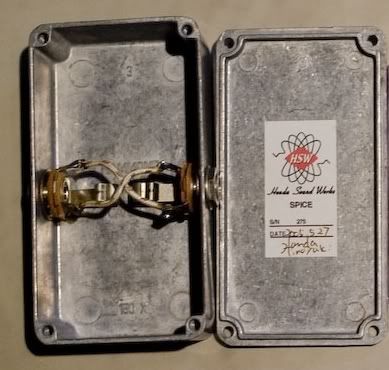
YOU KNOW NOTHING OF THE TRANSPARENCY OFFERED BY MY HONDA SOUND WORKS "SPICE"
Moderator: Ghost Hip


sonidero wrote:Roll a plus 13 for fire and with my immunity to wack I dodge the cough and pass a turn to chill and look at these rocks...
kbithecrowing wrote:Making out with my girl friday night, I couldn't stop thinking about flangers.



Or just have your buffer after your primitive and oscillating fuzz. (My Zoom Ultrafuzz is actually buffered bypass, and a pretty good buffer, so that's the last of that stuff.)goroth wrote:but if you rely on the impedance loading of your pickups/cables to get a fuzz to behave (like a fuzz face, or an oscillating fuzz) then you can't have an input buffer, and you just have to deal with stuff behaving differently.
D.o.S. wrote:Broadly speaking, if we at ILF are dropping 300 bucks on a pedal it probably sounds like an SNES holocaust.
friendship wrote:death to false bleep-blop
UglyCasanova wrote:brb gonna slap my dick on my stomp boxes


Mike wrote:A little known fact about the standard blue 3PDT switches is that, at moderately high volumes, the spring and the metal actuator contained within the switch can create phase-aligned sympathetic resonances, both sub-harmonic and super-harmonic. While you can't actually hear the dreaded "blue 3PDT resonance"-- a term coined in the early 1980s-- the frequencies do interact with frequencies in the audible range, resulting in unpredictable frequency cancellation.PetZounds wrote:Let's try to perpetuate some rumors about true bypass.
This can be minimized during the switch manufacturing process by using a specific quantity and type of grease to lubricate the mechanical components of the switch. Unfortunately, near the end of the 1970s, international agreements were put in place that prohibited the use of that lubricant due to its high toxicity. A suitable substitute was found, however it is very heat-sensitive. Simply soldering the switch changes the viscosity of the lubricant, and that all but guarantees that you will experience the dreaded blue 3PDT resonance.
That is why your setup sounds good most of the time, but some days, it just doesn't sound right. Maybe it is dull, maybe it sounds like there is a blanket over the speakers, maybe it just sounds different than you remembered. That, my friends, is the dreaded blue 3PDT resonance. It stifles creativity, and must be avoided at all costs.
If you must use a bypass, buffered bypass is the only way to go. Anyone who uses true bypass is a fool.

This though, this is the real issue. Do you guys... turn pedals off? That ain't right. All on all the time.Mike wrote:If you must use a bypass



rfurtkamp wrote:The only transparent thing I own is a set of drinking glasses.





KLON KLON KLON KLONTom Dalton wrote:Like a phoenix's butt, it will rise from the asses.
zRobertez wrote:I don't even turn my pedals on
Buffers are bitches - don't need em
KLON KLON KLON KLONTom Dalton wrote:Like a phoenix's butt, it will rise from the asses.

Seems pretty reasonable. We've all been there.Mike wrote:A little known fact about the standard blue 3PDT switches is that, at moderately high volumes, the spring and the metal actuator contained within the switch can create phase-aligned sympathetic resonances, both sub-harmonic and super-harmonic. While you can't actually hear the dreaded "blue 3PDT resonance"-- a term coined in the early 1980s-- the frequencies do interact with frequencies in the audible range, resulting in unpredictable frequency cancellation.PetZounds wrote:Let's try to perpetuate some rumors about true bypass.
This can be minimized during the switch manufacturing process by using a specific quantity and type of grease to lubricate the mechanical components of the switch. Unfortunately, near the end of the 1970s, international agreements were put in place that prohibited the use of that lubricant due to its high toxicity. A suitable substitute was found, however it is very heat-sensitive. Simply soldering the switch changes the viscosity of the lubricant, and that all but guarantees that you will experience the dreaded blue 3PDT resonance.
That is why your setup sounds good most of the time, but some days, it just doesn't sound right. Maybe it is dull, maybe it sounds like there is a blanket over the speakers, maybe it just sounds different than you remembered. That, my friends, is the dreaded blue 3PDT resonance. It stifles creativity, and must be avoided at all costs.
If you must use a bypass, buffered bypass is the only way to go. Anyone who uses true bypass is a fool.
zRobertez wrote:I find my tone is actually enhanced if I plug straight into the speakers


OddKnowledge wrote:I plug my guitars right into peoples' ears. you've gotta cut out everything and get the most true-bypass possible.

OMG I knew I could hear the frequencies interacting with frequencies in the audible range, resulting in unpredictable frequency cancellation!Mike wrote:A little known fact about the standard blue 3PDT switches is that, at moderately high volumes, the spring and the metal actuator contained within the switch can create phase-aligned sympathetic resonances, both sub-harmonic and super-harmonic. While you can't actually hear the dreaded "blue 3PDT resonance"-- a term coined in the early 1980s-- the frequencies do interact with frequencies in the audible range, resulting in unpredictable frequency cancellation.
This can be minimized during the switch manufacturing process by using a specific quantity and type of grease to lubricate the mechanical components of the switch. Unfortunately, near the end of the 1970s, international agreements were put in place that prohibited the use of that lubricant due to its high toxicity. A suitable substitute was found, however it is very heat-sensitive. Simply soldering the switch changes the viscosity of the lubricant, and that all but guarantees that you will experience the dreaded blue 3PDT resonance.
That is why your setup sounds good most of the time, but some days, it just doesn't sound right. Maybe it is dull, maybe it sounds like there is a blanket over the speakers, maybe it just sounds different than you remembered. That, my friends, is the dreaded blue 3PDT resonance. It stifles creativity, and must be avoided at all costs.
If you must use a bypass, buffered bypass is the only way to go. Anyone who uses true bypass is a fool.

TAKE. A. BOW.Mike wrote:A little known fact about the standard blue 3PDT switches is that, at moderately high volumes, the spring and the metal actuator contained within the switch can create phase-aligned sympathetic resonances, both sub-harmonic and super-harmonic. While you can't actually hear the dreaded "blue 3PDT resonance"-- a term coined in the early 1980s-- the frequencies do interact with frequencies in the audible range, resulting in unpredictable frequency cancellation.PetZounds wrote:Let's try to perpetuate some rumors about true bypass.
This can be minimized during the switch manufacturing process by using a specific quantity and type of grease to lubricate the mechanical components of the switch. Unfortunately, near the end of the 1970s, international agreements were put in place that prohibited the use of that lubricant due to its high toxicity. A suitable substitute was found, however it is very heat-sensitive. Simply soldering the switch changes the viscosity of the lubricant, and that all but guarantees that you will experience the dreaded blue 3PDT resonance.
That is why your setup sounds good most of the time, but some days, it just doesn't sound right. Maybe it is dull, maybe it sounds like there is a blanket over the speakers, maybe it just sounds different than you remembered. That, my friends, is the dreaded blue 3PDT resonance. It stifles creativity, and must be avoided at all costs.
If you must use a bypass, buffered bypass is the only way to go. Anyone who uses true bypass is a fool.


What the fuck!!!!!!!!! I'm sure it's super transparent. Does it work like a crystal lattice?Achtane wrote:ATTN BUFFER FANS: EAT MY FUCK
YOU KNOW NOTHING OF THE TRANSPARENCY OFFERED BY MY HONDA SOUND WORKS "SPICE"