Can anyone explain them to me, how/why they work.
Can you make an octave up circuit and graft it on to any pedal?
I am new to this game so any tips are helpful.
Thanks.
Octave up effects.
Moderator: Ghost Hip
Forum rules
The DIY forum is for personal projects (things that are not for sale, not in production), info sharing, peer to peer assistance. No backdoor spamming (DIY posts that are actually advertisements for your business). No clones of in-production pedals. If you have concerns or questions, feel free to PM admin. Thanks so much!
The DIY forum is for personal projects (things that are not for sale, not in production), info sharing, peer to peer assistance. No backdoor spamming (DIY posts that are actually advertisements for your business). No clones of in-production pedals. If you have concerns or questions, feel free to PM admin. Thanks so much!
-
McSpunckle
- IAMILFFAMOUS

- Posts: 3848
- Joined: Mon Oct 06, 2008 10:20 am
- Location: Nashville, TN
Re: Octave up effects.
You can add an octave up to whatever you want. I'd stick with distortion effects, but, you know, why not. If you're just going to put it at the beginning or end of a circuit, IMO, just build it into its own box and make it modular.
ANYWAYS, how they work. It's called "full wave rectification." Read up here:
http://www.allaboutcircuits.com/vol_3/chpt_3/4.html
I don't fully get how it works, honestly, but you'll notice that some of the circuits shows in that look an awful lot like the output of an octavia (by that, I mean exactly the same).
The waveform does look like it's twice the frequency... but there's no negative side anymore. I did some searching, and only found sort of overly-complex explanations that didn't seem to say anything.
ANYWAYS, how they work. It's called "full wave rectification." Read up here:
http://www.allaboutcircuits.com/vol_3/chpt_3/4.html
I don't fully get how it works, honestly, but you'll notice that some of the circuits shows in that look an awful lot like the output of an octavia (by that, I mean exactly the same).
The waveform does look like it's twice the frequency... but there's no negative side anymore. I did some searching, and only found sort of overly-complex explanations that didn't seem to say anything.
-
smallsnd/bigsnd

- IAMILFFAMOUS
- Posts: 3981
- Joined: Sat Nov 29, 2008 12:57 pm
Re: Octave up effects.
one thing to note is that you generally need a bit of gain to rectify a typical guitar signal. that's why if you've ever used a passive ring modulator on a guitar, the output can be pretty weak... putting an octave up snippet AFTER a distortion/boost will most likely give better results than before the gain stage. ...or just try sticking it in the middle of 2 different gain stages if you want more/different options.
-
McSpunckle
- IAMILFFAMOUS
- Posts: 3848
- Joined: Mon Oct 06, 2008 10:20 am
- Location: Nashville, TN
Re: Octave up effects.
If you use, like, a full Green Ringer circuit, it has a booster. Of course, if you have enough gain already, you can leave out that booster.
-
KK25
- uncommitted

- Posts: 9
- Joined: Sat Jun 05, 2010 11:28 pm
- Location: NSW Australia
Re: Octave up effects.
For analogue (analog depending on where you're from!) octave up, diodes arranged in a 'bridge' are used for full wave rectification of the signal. Basically that means that either the positive or negative 'half wave' of a full sine, gets inverted. With analogue octave up pedals there are never any tracking issues. Analogue octave up doesn't rely on tracking.
If you look at this sine, you can see that the positive part of the wave runs from 0 - 25ms. The negative half of the sine goes from 25 - 50ms. One full cycle of this wave is then 50ms which determines its frequency.

If you full wave rectify the signal to look something like this next image, the negative part of the wave gets inverted up onto the positive side. You now have a waveform that repeats itself every 25ms rather than every 50ms. You have just doubled its frequency so you now have a sound that is an octave higher than before. This full wave rectification of the input signal will remove the original tone altogether. This is because your fundamental has just been doubled.
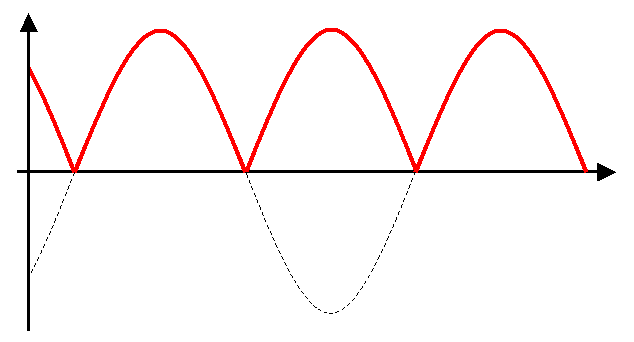
Analogue octave up has a fuzz sound to it. The reason you have some fuzz when you do this is because the wave is changing direction very suddenly rather than nice and smooth like before. Same principal behind why a square wave sounds fuzzy... Sometimes you can also get funny ring modulator like overtones being produced. This is because unlike the full wave rectified sine waves in the pic, your guitar / bass (whatever) doesn't produce a perfect sine. The signal has harmonics and all sorts of rubbish attached to it. This method of analogue octave up rectifies the whole lot and so you can end up with some weird noises going on.
If you want to retain some of the original tone, you can use half wave or partial wave rectification to retain something more like the original signal frequency. The octave effect is obviously then less dramatic.
Half Wave

Hopefully some of that makes some kind of sense...?
If you look at this sine, you can see that the positive part of the wave runs from 0 - 25ms. The negative half of the sine goes from 25 - 50ms. One full cycle of this wave is then 50ms which determines its frequency.
If you full wave rectify the signal to look something like this next image, the negative part of the wave gets inverted up onto the positive side. You now have a waveform that repeats itself every 25ms rather than every 50ms. You have just doubled its frequency so you now have a sound that is an octave higher than before. This full wave rectification of the input signal will remove the original tone altogether. This is because your fundamental has just been doubled.
Analogue octave up has a fuzz sound to it. The reason you have some fuzz when you do this is because the wave is changing direction very suddenly rather than nice and smooth like before. Same principal behind why a square wave sounds fuzzy... Sometimes you can also get funny ring modulator like overtones being produced. This is because unlike the full wave rectified sine waves in the pic, your guitar / bass (whatever) doesn't produce a perfect sine. The signal has harmonics and all sorts of rubbish attached to it. This method of analogue octave up rectifies the whole lot and so you can end up with some weird noises going on.
If you want to retain some of the original tone, you can use half wave or partial wave rectification to retain something more like the original signal frequency. The octave effect is obviously then less dramatic.
Half Wave
Hopefully some of that makes some kind of sense...?
-
McSpunckle
- IAMILFFAMOUS
- Posts: 3848
- Joined: Mon Oct 06, 2008 10:20 am
- Location: Nashville, TN
-
KK25
- uncommitted
- Posts: 9
- Joined: Sat Jun 05, 2010 11:28 pm
- Location: NSW Australia
Re: Octave up effects.
Love you too man 
-
tuffteef

- IAMILFFAMOUS
- Posts: 7890
- Joined: Tue May 26, 2009 7:05 pm
- Location: Downunderverse

-
eatyourguitar

- IAMILFFAMOUS
- Posts: 3127
- Joined: Sun Oct 03, 2010 12:37 pm
- Location: USA, RI
Re: Octave up effects.
foldover distortion is another way to do it. also caled a wave folder.
WWW.EATYOURGUITAR.COM <---- MY DIY STUFF
-
StudioShutIn
Re: Octave up effects.
eatyourguitar wrote:foldover distortion is another way to do it. also caled a wave folder.
And that is what the Source Audio Multiwave Distortion does, right?
-
Rygot
- FAMOUS

- Posts: 1381
- Joined: Sat May 08, 2010 11:07 am
- Location: Columbus, Ohio
- Contact:
Re: Octave up effects.
I feel enlightened after reading that...
-
eatyourguitar
- IAMILFFAMOUS
- Posts: 3127
- Joined: Sun Oct 03, 2010 12:37 pm
- Location: USA, RI
Re: Octave up effects.
oh and dont forget DSP. they just sample your sound into digital and play it back twice as fast in a loop. when the signal swings back and forth for a complete 360 it hard syncs the playback of the loop in the start phase and resamples your input to make the next waveform/loop.
WWW.EATYOURGUITAR.COM <---- MY DIY STUFF